
106-AC Anti-Cavitation Control Valve
The 106-AC series control valve is designed to solve high pressure drop problems by allowing smooth control and protection from cavitation damage. It’s ideal for applications where large pressure differentials preclude the use of standard automatic control valves and varying flows make orifice plates ineffective.
The AC control valve contains two heavy stainless steel sliding cages that maximize the full flow capacity. The first cage directs and contains the cavitation recovery, allowing it to dissipate harmlessly. While the second cage allows further control to a level as low as atmospheric pressure downstream. The cages are engineered to meet the flow / pressure differential of each application.
- Solves high pressure drop problems
- Controls variable flows & vibration
- Significantly reduces noise
- Self-contained – actuators not required
Customizable to meet your application needs

106 / 206-F-Type 5 Non-Modulating Float Valve
The 106-F-Type 5 and 206-F-Type 5 non-modulating float valves are based on the 106-PG or 206-PG main valve. It is ideal for allowing normal forward flow to fill water reservoirs to a desired high level and where the pilot and valve of the reservoirs are easily accessible.
The valve functions as a two position valve, either open or closed. The valve remains closed when the reservoir level drops, until the float reaches the pre-determined adjustable minimum reservoir level. The F-Type 5 valve then opens to refill the reservoir and closes tightly when high water level is achieved.
- No overflow, drip-tight close
- Adjustable draw down
- Easily adjustable level settings
- Low supply pressure options
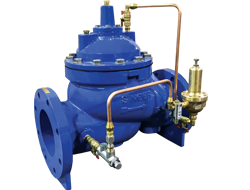
106 / 206-PR Pressure Reducing Valve
The 106-PR and 206-PR series pressure reducing valves are based on the 106-PG or 206-PG main valves.
The pilot valves sense the downstream pressure through a connection at the valve outlet. Under flowing conditions, the pilot reacts to small changes in pressure to control the valve position by modulating the pressure above the diaphragm. The downstream pressure is maintained virtually steady at the pilot set-point.
In typical pressure reducing applications, the reduced port model 206-PR is often the best selection.
- Ideal for maintaining accurate downstream pressure
- Responds quickly and effectively

106 / 206-RPS Sustaining – Pressure Sustaining Valve
The 106-RPS and 206-RPS pressure sustaining valves are based on the model 106-PG or 206-PG main valve.
The 81-RP pilot senses the upstream pressure through a connection to the valve inlet. The valve and pilot remain closed until the inlet pressure exceeds the pilot setting.
Under flowing conditions, the pilot reacts to small changes in pressure to control the valve position by modulating the pressure above the diaphragm.
Should the upstream pressure fall below the set-point, the valve will close or modulate to ensure that the set-point is maintained.
- Ensures minimum upstream pressure for critical use
- Easily adjustable pressure setting
- Closes if inlet pressure drops below set-point
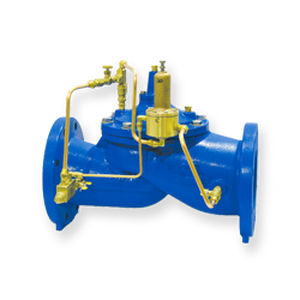
106 / 206-RPS Relief Pressure Relief Valve
The 106-RPS and 206-RPS pressure relief valves are based on the 106-PG and 206-PG main valves.
The 81-RP pilot senses the upstream pressure through a connection to the valve inlet. The valve and pilot remain closed until the inlet pressure exceeds the pilot setting. The valve opens rapidly to relieve damaging overpressure and closes smoothly at an adjustable speed, when the pressure returns below the set-point. The upstream pressure is limited to the pilot set-point.
- Limits system pressure by relieving excess flow
- Quick opening relief
- Easily adjustable pressure setting

106 / 206-PR-SM Pressure Reducing Control Valve with Integral Back-up
The 106-PR-SM and 206-PR-SM series control valves are engineered to be used anywhere pressure reducing valve failure is unacceptable. These valves have a second and independent operating system superimposed upon the standard primary system. With the assurance of a back-up system, maintenance schedules may be extended as pressures will continue to be controlled even in the event of failure with the primary system.
Under normal pressure reducing conditions, the primary pilot senses the downstream pressure through a connection at the valve outlet. Under flowing conditions, the pilot reacts to small changes in pressure to control the valve position by modulating the pressure above the diaphragm in the lower operating chamber. The downstream pressure is maintained virtually steady at the pilot set-point that is adjustable.
Should the primary pilot system and / or main valve fail to control the downstream pressure, the independent back-up pilot system will begin to operate. It controls the pressure above the diaphragm in the second operating chamber. The back-up pilot is set slightly higher than the primary pilot. The forces now operating in the top chamber assume control of the inner valve assembly and maintain pressure reducing control. During back-up operation only, there is a small (1 USGPM / 0.063 L/s) continuous discharge that should be taken to drain.
The secondary pilot continually senses the downstream pressure. Should there be a rapid rise in downstream pressure for any reason, the secondary pilot will respond quickly, and will pressurize the top chamber. This will compliment the primary pressure reducing controls and provide faster response.
- Ideal for applications where failure is not an option
- Includes a back-up system to protect against diaphragm or pilot failure
- Reduces unnecessary maintenance
- Provides downstream surge protection

MCP-TP Multi Process Control Panel Series
The MCP-TP Series is a multiple process loop control panel designed to complement the Singer Model 2SC-PCO Dual Solenoid Control Valve. Range of application is dependent on the feedback (process variables) transmitters used, which is similar to (but not limited to) combination automatic control valve functions with conventional pilots.
The MCP-TP control panel has the ability to monitor multiple processes and remotely control the dual solenoid control valve based on system conditions. The MCP-TP control panel can function as a simple single loop controller (e.g., pressure reducing, flow control, level control to multiple loop controller.)
The MCP-TP reads transmitted signals and energizes the dual solenoid pilots on the Singer control valve. The MCP-TP can react to any change in conditions by monitoring the system continuously and comparing actual process values to desired set-point values.
Optional alarm outputs for SCADA is available.
Note: Due to the many different specifications of the MCP, please contact our Customer Service Group to request your Operations Guide.
- Versatility in programming for custom applications
- Flexibility of single or multiple process monitoring
- High performance PLC-based control with P.I.D. optimization
- Capability of remote SCADA 4 – 20 mA or local set-point(s) adjustment
- Precise valve positioning
- Visual status indication
- Robust and self-contained in NEMA 4X rated panel
- Intuitive colour touch screen interface display
- Capable of local control of model 2SC-PCO dual solenoid valves
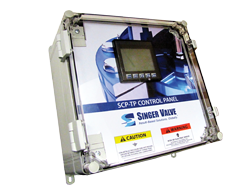
SCP-TP Single Process Control Panel Series
The SCP-TP Controller is a simplified process controller designed to complement the Dual Solenoid Control Valve. It offers quick and easy configuration for any single process application as well as on/off applications. The SCP-TP is also equipped to be configured to control the Singer 420DC Motor. Range of application is dependent on the process variable (feedback) transmitter used, which includes (but not limited to) common automatic control valve functions with conventional pilots.
The SCP-TP Controller reads and compares the process feedback (process variable) 4 to 20 mA signal to the desired setting (set-point) 4 to 20 mA signal. The SCP-TP then accurately positions the valve to bring the process variable towards the set-point until they coincide. The SCP-TP is also equipped with data logging features that when enabled can log all sensor feedback and setpoint data with a time stamp.
- Compatibility with remote SCADA Modbus, Hardwired 4 to 20 mA or local set-point adjustment
- Simplified single loop process controller with P.I.D. implementation, ON/OFF or 4-20mA motor control
- Selectable input controls and output alarms
- IP 66, 67 NEMA 4X rated panel
- Colour touch screen interface display
- Equipped with data logging features